
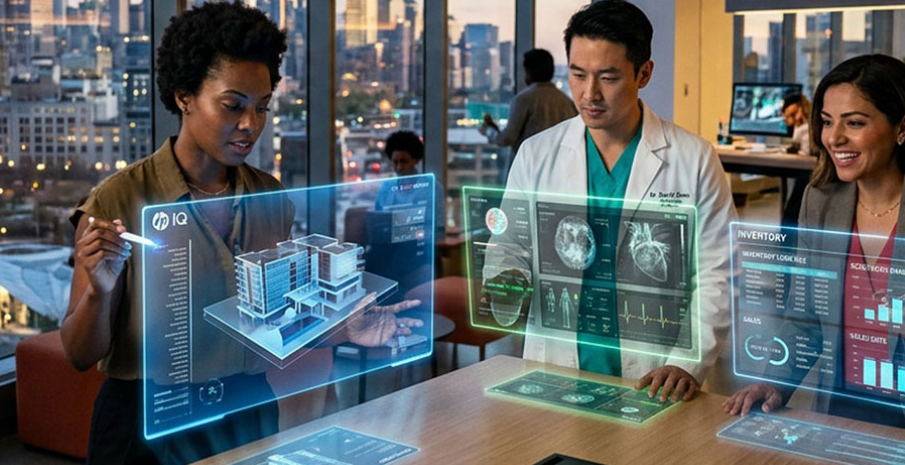
The tech industry has long centered on the cloud as the primary hub for computing and data. At HP Imagine 2026 in New York last week, HP made a clear case for pushing more of that intelligence to the edge, emphasizing AI workloads running locally on devices and enterprise workstations.
This shift reflects a broader transition in enterprise AI. Rather than experimenting with standalone tools, companies are beginning to integrate AI directly into workflows and devices. HP’s vision centers on AI running locally as part of everyday computing, rather than as a remote service accessed through the cloud.
Let’s look at what HP introduced at Imagine 2026 and what it signals for enterprise computing. We’ll close with my Product of the Week, the HP EliteBook 6 G2q, which showcases how the company is positioning its next-generation AI PCs.
Leadership Shift and Execution
Before diving into the hardware, it’s worth noting HP’s internal transformation. Leadership changes, including a new CEO and a streamlined structure, typically raise questions about execution. At Imagine 2026, HP focused on showing progress rather than addressing those concerns directly.
While competitors like Dell and Lenovo continue to emphasize general-purpose AI PCs, HP is leaning more heavily into domain-specific use cases. The company argues that AI models will increasingly be tailored to specific industries and workflows and is positioning its portfolio accordingly.
HP is also trying to balance its reputation for reliability with newer initiatives like Google Beam and edge-based AI systems. That approach reflects an effort to modernize its portfolio while maintaining the security and compliance standards expected by enterprise customers.
The Economics of Edge AI
One of the more notable themes at the event was what HP described as the “AI tax” — the growing cost of running AI workloads in the cloud. The company framed this as a scaling issue, where API usage and infrastructure costs can rise quickly as more employees rely on AI tools.
HP’s response is to run more inferencing on local devices. By running models on workstations and PCs rather than relying entirely on the cloud, the company argues that organizations can reduce both latency and ongoing usage costs.
The company is backing that strategy with more powerful hardware. HP pointed to systems like the ZBook Fury, with significantly higher AI processing capacity, and projected continued gains in on-device performance over the next several years. It also demonstrated large language models running locally on a workstation, underscoring its push toward keeping data and processing on-device.
This approach also aligns with growing interest in “sovereign AI,” where organizations keep sensitive data and AI processing within their own infrastructure rather than relying on external cloud services.
Connecting AEC Workflows End to End
One of the more fully developed areas HP focused on was its end-to-end ecosystem for Architecture, Engineering, and Construction (AEC) professionals. HP outlined a workflow designed to connect design, simulation, and on-site execution:
- Model/Simulate: HP Workspace enables teams to upload changes and review visual differences across design versions.
- Design: Powered by the Z6i Fury AI workstation, which includes a modular design to support future hardware upgrades and larger GPU configurations.
- Physical Execution: Designs can be output through DesignJet printers and extended to tools like the SitePrint robot, which translates plans directly onto construction surfaces.
The approach reflects HP’s effort to connect hardware, software, and output devices into a more unified workflow. While competitors often focus on specific parts of that process, HP is building around a broader integrated stack for AEC environments.
3D Collaboration Without Headsets
Google Beam was a central collaboration announcement at the event, now part of HP’s expanding portfolio. Rather than relying on VR headsets or AR glasses, the approach enables 3D communication without requiring users to wear additional hardware.
HP Dimension with Google Beam, expected later in 2026, aims to deliver a more immersive 3D communication experience. The system is intended to create a stronger sense of presence without requiring headsets, positioning it as an alternative to traditional video conferencing and more complex AR/VR setups.
If successful, this approach could appeal to organizations looking for more immersive collaboration without the cost and complexity of headset-based systems.
Vertical Innovation: Retail, Clinical, and Travel
HP is applying edge AI to specific industry use cases:
- Retail: Systems can identify returning customers and provide staff with real-time insights to support more personalized service.
- Clinical: Local inferencing can support more personalized patient insights and assist with treatment recommendations.
- Travel: Partnerships aimed at improving real-time routing and identification could help streamline airport security and passenger flow — something many of us could have used recently.
These examples point to a broader shift from standalone features to measurable business outcomes. HP also projects that a growing share of AI inferencing will move to the edge over time. By combining hardware, software, and services, the company is working to play a larger role across that ecosystem.
HP IQ and On-Device AI
While much of the industry still relies on cloud-based assistants, HP IQ reflects HP’s push toward a more local-first AI model.
Developed in part by a team led by former Apple and Humane designer Imran Chaudhri, HP IQ is built around a large local model that runs directly on the device. Rather than operating as a standalone app, it integrates across the system, supporting features like natural-language assistance and automated meeting notes.
HP IQ also integrates with HP NearSense, which enables nearby devices to detect and interact with one another. This allows users to move files, datasets, or presentations between devices more seamlessly in shared environments.
By prioritizing on-device processing, HP IQ helps reduce reliance on cloud resources while keeping sensitive data within local systems.
Enterprise Hardware and Security
HP introduced updates across its enterprise hardware lineup. The EliteBook 6 G2q is positioned as a flagship AI PC, with improved on-device processing and extended battery life. The company also called out potential gains in tasks like contract review using local AI.
Security was another focus area, with additions such as HP TPM Guard, which is designed to strengthen protections between hardware components and defend against more advanced physical and side-channel attacks. HP also introduced updates across its printer lineup, including features to address longer-term encryption and data protection concerns.
HyperX and Gaming Strategy
HP has continued to expand its gaming presence under the HyperX brand. By shifting more of its peripheral focus from Omen to HyperX, the company is targeting a broader prosumer audience.
Discover more
cloud-based
Software
science
There is some overlap between high-performance workstations and gaming peripherals, particularly in areas like input precision and responsiveness. HP appears to be aligning these product categories to appeal to users who value performance across both work and personal use.
Wrapping Up: HP’s Direction on Edge AI
HP Imagine 2026 highlighted the company’s evolution beyond traditional PCs and printers toward a broader focus on platforms and AI-driven capabilities.
The strategy centers on integrating AI more directly into devices, reducing reliance on cloud infrastructure, and improving collaboration tools, while maintaining a strong emphasis on security and data control.
Despite recent leadership changes, HP is emphasizing execution and alignment around its edge AI strategy, positioning itself to support enterprises as they expand their use of AI across workflows and environments.
The HP EliteBook 6 G2q

Image Credit: HP
In the tech industry, we often talk about “inflection points” — moments where hardware and software meaningfully change how we work, rather than simply improving performance. The HP EliteBook 6 G2q may be an early example of that shift.
While many early AI PCs have offered incremental updates, the EliteBook 6 G2q stands out for its focus on on-device AI performance. Built on the Snapdragon X Elite platform, it delivers up to 85 TOPS of NPU processing — a significant step up from first-generation systems and enough to support more complex local AI workloads.
For highly mobile workers, battery life and portability remain critical. The system offers up to 28 hours of battery life and a thinner, lighter design, making it well-suited for extended use away from a desk.
That said, there’s still room for design experimentation. HP’s earlier Folio form factor offered a distinctive approach to ergonomics, and pairing that kind of design with current AI performance could open up interesting possibilities.
More importantly, the 6 G2q serves as a platform for HP IQ, the company’s emerging AI software layer. Running these capabilities locally requires higher on-device performance, and systems like this are designed to support that shift. If HP IQ gains traction, hardware like the 6 G2q could become a key part of that strategy.
The HP EliteBook 6 G2q is expected to be available on HP.com in July. Pricing will be provided closer to availability.
If you are a mobile professional who needs to stay connected (the 5G carrier switching is a nice touch) and want to be on the leading edge of the AI revolution rather than just reading about it, the EliteBook 6 G2q is currently the gold standard and my Product of the Week.
About the Author