
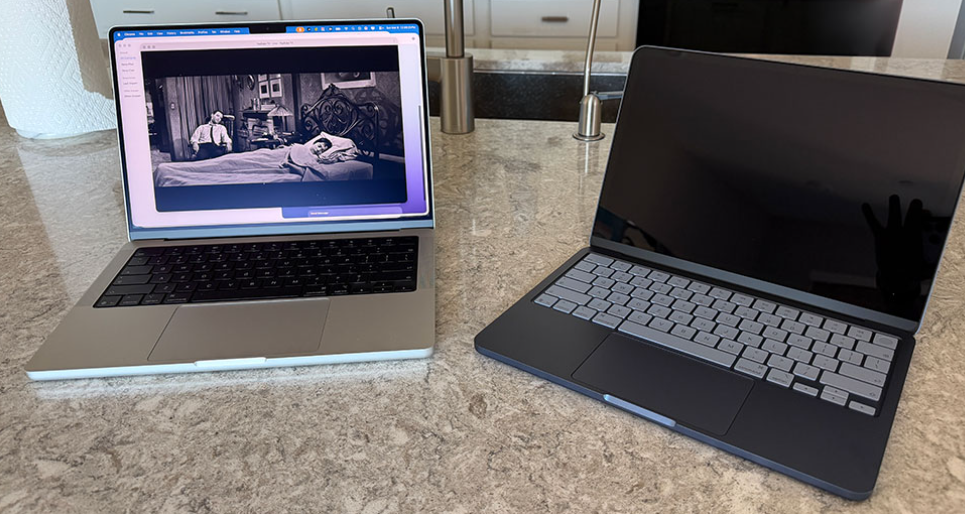
Apple’s latest Mac announcements may look like routine upgrades. Look closer, and a deliberate strategy behind the new MacBook Neo and updated MacBook Pro lineup becomes clear.
On one end, Apple pushed the MacBook Pro further upmarket with M5 Pro and M5 Max silicon, a new Fusion architecture, more memory bandwidth, faster storage, and AI and graphics capabilities that keep creative pros, developers, and power users (like me) firmly in Apple’s camp.
On the other end, it opened a new low-cost door with the MacBook Neo at $599, a machine designed to pull first-time buyers, budget families, and education users into the Mac ecosystem without turning the Mac into a bargain-bin product.
Apple did not announce a completely retooled MacBook Pro in these briefings, though that continues to be the rumor for later in the year or perhaps early 2027. The premium MacBook Pro update focused primarily on enhancements to the M5 Pro and M5 Max processors.
That is the bigger story here. Apple did not simply launch faster premium laptops and a cheaper laptop at the same time. It is building a ladder. The bottom rung is now more reachable for mainstream users with limited budgets. The upper rungs still look aspirational and distinctly more capable. That is how you drive incremental sales without collapsing your pricing and margin structure.
Why MacBook Neo Matters Beyond the Specs
The MacBook Neo specifically addresses students, first-time Mac buyers, budget-conscious families, and education users — groups Apple has often approached only indirectly, though it has had prior success in the educational market.
For years, schools, parents, and shoppers on a tight budget have chosen Chromebooks or low-cost Windows notebooks as practical solutions, while Apple largely steered clear of that battle. With the Neo at $599, Apple positions itself to serve students needing an affordable device for classwork, families looking for reliable technology on a budget, and new users entering the Mac ecosystem without sacrificing the Mac’s identity.
That point matters because the goal is not just to sell a cheap laptop. As my Technologists colleague Marco Chiappetta pointed out last week on a podcast, netbooks soured many PC OEMs because these low-cost PCs in the 2007 timeframe ended up cannibalizing more profitable, higher-end PCs.
Apple’s goal is to acquire a customer earlier. A child who starts with a MacBook Neo for schoolwork, web use, messaging, and light creation is far more likely to grow into an iPhone, iPad, AirPods, iCloud, and eventually a MacBook Air or MacBook Pro customer. Apple has always understood the lifetime value of customers. What it has lacked in the notebook market is a truly mass-market entry point that still feels unmistakably Apple.
Apple Is Borrowing a Playbook It Knows Well
The company has already shown on the iPhone side that it knows how to broaden the funnel without giving away the brand.
In my discussions with the company prior to the Neo announcement, Apple repeatedly stressed longevity, strong core performance, and value retention for a lower-priced iPhone, while still protecting the halo around higher-end models.
That same logic is now showing up on the Mac side. The message is simple: entry products should feel durable and capable, not disposable, because longevity is part of the value story for budget-conscious buyers.
That is also why the Neo appears designed to avoid the “cheap Mac” stigma. It is a line that Cupertino will not cross. Apple focused on preserving its core design language and aluminum construction while lowering costs through manufacturing and component choices rather than by using visibly inferior materials. That decision is a classic Apple move. It protects brand equity while still expanding the addressable market.

Available in four spiffy color finishes that are family and school-friendly — silver, blush, citrus, and indigo — the Neo is priced at $599 for the 256GB model and $699 for the 512GB version. (Image Credit: Apple)
What’s Clever Is Where Apple Chose to Compromise
To be sure, the Neo works strategically only if Apple makes the right compromises.
The device cannot be so weak that buyers reject it. It also cannot be so good that it causes a parent, student, or casual prosumer to skip the MacBook Air or base MacBook Pro.
Apple appears to have threaded that needle by using an iPhone 16-vintage A18 Pro rather than a full M-series Mac chip, while still delivering performance roughly comparable to the M1 era for many everyday tasks and better than the M1 in single-core benchmarks.
Early benchmark results showed the Neo’s A18 Pro system at around 3,461 single-core and 8,668 multicore in Geekbench, while other benchmarks noted A18 Pro single-core performance above M1 levels.
That tells us exactly who this machine is for: students who need a dependable device for homework or class projects, newcomers entering the Apple ecosystem, families seeking affordable computers, and education users focused on everyday tasks.
The Neo is not for someone who cuts complex 8K video, compiles huge codebases all day, or drives heavy 3D workflows. Instead, it is designed for homework, browsing, streaming, messaging, cloud apps, light photo work, basic content creation, and occasional local AI features. That is enough to capture a large share of the education and family market. More importantly, it is enough to make the Neo feel like a real Mac instead of a compromised side project.
One of the first things you’ll notice about the Neo is that it has only two USB-C ports (compared with three on the MacBook Pro) and no MagSafe power connector. This configuration means you’ll need to use one of those ports to charge it.
It’s worth noting that these are not high-performance Thunderbolt 5 ports, so they might not be the best choice if you’re looking to attach super-fast external storage. Also, unlike the MacBook Pro, it doesn’t have an integrated HDMI port or a memory card slot.
The High End Still Leads
Putting those caveats aside, Apple seems aware it cannot pursue the low end at the expense of the performance reputation the Mac business has built over the last five years.
Apple says that the M5 Pro uses an 18-core CPU with six “super cores” and 12 new performance cores for up to 30% faster multi-threaded performance than the M4 Pro, while the M5 Max scales that with up to a 40-core GPU and much higher memory bandwidth. Apple added that the MacBook Pro still delivers up to 24 hours of battery life, which is crucial because Apple’s performance story has never been just about speed. It is speed per watt.
Early benchmark chatter suggests Apple kept its foot on the gas. One set of reported M5 Max Geekbench results showed about 4,268 single-core and 29,233 multi-core scores, with a Metal score of 232,718, placing it in striking distance of, or ahead of, much larger prior Apple desktop-class systems in some measures. Benchmarks are never the whole story, but they reinforce the broader point. Apple did not water down the top of the stack while building the bottom.
Though I haven’t put the fully configured MacBook Pro M5 Max that Apple sent me through its paces yet, I can report this new MacBook Pro simply feels dramatically faster. A 25-minute video podcast I produced using Wondershare Filmora rendered nearly 50% faster than on the MacBook Pro M4 Max I’ve been using for the past year. That is certainly not a trivial increase in performance and productivity.

The MacBook Pro anchors the high-performance tier of Apple’s Mac lineup, pairing M5-series silicon with expanded connectivity, including additional USB-C ports and other pro-class I/O. (Photo by Author)
Why Neo Doesn’t Cannibalize MacBook Pro
To be sure, Apple’s biggest concern with any low-cost notebook is cannibalization. But the MacBook Pro is protected by more than just a chip speed delta.
Apple spent much of the Mac briefing emphasizing pro workflows rather than generic computing. Online demos centered on local agentic coding, architecture visualization, generative AI image pipelines, and advanced media workflows.
Apple also highlighted the new Fusion architecture, up to 64GB of unified memory on M5 Pro and up to 128GB on M5 Max, more than 300 GB/s of memory bandwidth on M5 Pro and more than 600 GB/s on M5 Max, faster SSD performance, and substantial GPU and AI scaling.
The MacBook Pro customer is paying for throughput, headroom, and time savings. That is a totally different buyer. A video editor, developer, architect, or AI power user is not going to look at a $599 Neo and say, “good enough.” They will immediately see what is missing. That is the beauty of the portfolio design. Apple is not protecting Pro by artificially crippling Neo alone. It is protecting Pro by making Pro meaningfully better for real workloads.
MacBook Air Remains the Crucial Middle Layer
It is easy to focus on the flashy extremes, but the middle matters just as much. The M5 MacBook Air is the bridge product that makes the whole portfolio work.
In the briefing, Apple framed the MacBook Air as the mainstream machine for consumers, students, and business users, featuring Apple Intelligence, 512GB of starting storage, faster storage, Wi-Fi 7, and an emphasis on portability and AI capabilities.
Apple also highlighted student workflows, on-device AI, parent photo organization, business productivity, and light content creation.
While the MacBook Air appears to be Apple’s volume play, the company now positions Neo as an entry-level product, with MacBook Air targeted at the mainstream and Pro for professionals. This segmentation keeps non-Pro buyers from being forced into a single option and reduces Neo’s threat to the Pro line, as most upgrades will flow through Air.
Chromebook Fight Is About Ecosystem, Not Price
Apple recognizes it will not beat Chromebooks by matching raw purchase prices line-for-line — and that is not the point.
The goal is to narrow the gap enough to shift the conversation from “Apple is too expensive” to “for a bit more, you get a real Mac that lasts longer, works better with your phone, and opens the door to a richer app and services ecosystem.” At $599 — which until now was unheard of for an Apple computer — that argument becomes far more plausible, especially for families that already own iPhones or iPads.
This setup is particularly relevant in education. Chromebooks won because they were cheap, manageable, and good enough. Apple’s answer now looks more strategic. Give students a durable, modern, low-cost Mac that still benefits from Apple Silicon efficiency and the company’s broader hardware and software integration. Once those students are inside the ecosystem, switching costs rise, and the loyalty loop strengthens.
Apple’s AI Positioning Quietly Supports This Strategy
Another notable takeaway from the briefing is how heavily Apple leaned into AI across the lineup. On the Air and Pro, Apple emphasized on-device AI, privacy, neural acceleration, local model support, and workflows that do not rely on the cloud.
That matters because AI is becoming a new way to differentiate even mainstream PCs. Apple is effectively saying that affordable does not have to mean obsolete, and that premium does not have to mean remote, cloud-dependent.
For the Neo, even if its AI ceiling is lower than Pro, it still benefits from Apple’s unified silicon strategy. That gives Apple a much stronger story than a generic low-cost Windows notebook vendor. The entry product is not an orphan. It inherits platform advantages from the rest of the family.
Portfolio Discipline
What Apple did last week was not just launch new products. It demonstrated portfolio discipline. The company understands the risk of opening the low end, but also knows the danger of ignoring it.
By creating separation through silicon tiering, workload positioning, memory bandwidth, graphics scale, storage, and likely display, port, and other experiential differences, Apple preserves the brand’s industrial design consistency. That is how you expand without eroding.
Could some buyers choose Neo instead of the Air? Yes. Might some Air buyers delay stepping up? Probably. The more important question, however, is whether Neo unlocks customers that Apple was not reaching before. I believe it does — particularly in households with multiple children, education deployments, and among first-time buyers who simply could not justify a four-figure starting price.
The Biggest Takeaway
The most important conclusion is this: Apple’s silicon strategy, now more than five years into the Mac transition, is the reason the MacBook Neo is even possible.
Once Apple brought chip design in-house and built a scalable architecture spanning iPhone-class and Mac-class devices, it gained enormous flexibility. The company can now repurpose, bin, scale, and segment silicon in ways that Intel-era Apple simply could not. The Neo is not a random budget experiment. It is the logical extension of that control.
That strategy is also why Neo is likely to be largely incremental for Apple rather than disruptive to its existing lineup.
- MacBook Pro remains the performance flagship.
- MacBook Air remains the mainstream heart of the lineup.
- MacBook Neo opens the front gate wider, especially for students and families on tighter budgets.
In other words, Apple is not lowering the bar for the Mac. It is widening the front door.
If Apple executes well, this will not cheapen the Mac. It will broaden the Mac line, strengthen Apple’s education push, and create a new generation of customers whose first real computing experience in the Apple ecosystem starts earlier and costs less than ever before.
The folks who scoffed at Apple for getting into the silicon business — and there were many — are not laughing now.
About the Author